new

Get trending papers in your email inbox!

Subscribe

Trending Papers

byAK and the research community

Trending Papers
Submitted by
taesiri

PaperBanana: Automating Academic Illustration for AI Scientists

_paperbanana is an agentic framework that automates the creation of publication-ready academic illustrations using advanced vision-language models and image generation techniques.

google Google · Jan 30, 2026
Submitted by
daixufang

Agent Lightning: Train ANY AI Agents with Reinforcement Learning

Agent Lightning is a flexible RL framework for training LLMs in various agents, using a hierarchical RL algorithm and decoupling execution from training to handle complex interactions.

  • 8 authors
· Aug 5, 2025
Submitted by
qiuyuu

Advancing Open-source World Models

LingBot-World is an open-source world simulator with high-fidelity dynamics, long-term memory capabilities, and real-time interactivity for diverse environments.

robbyant Robbyant · Jan 28, 2026

Scaling Large-Language-Model-based Multi-Agent Collaboration

Multi-agent collaboration networks enhance collective intelligence, outperforming baselines across various topologies and showing emergent abilities earlier than neural scaling laws suggest.

  • 10 authors
· Jun 11, 2024

Multi-Agent Collaboration via Evolving Orchestration

A centralized orchestrator dynamically directs LLM agents via reinforcement learning, achieving superior multi-agent collaboration in varying tasks with reduced computational costs.

  • 14 authors
· May 26, 2025

Multi-Agent Software Development through Cross-Team Collaboration

Cross-Team Collaboration improves software quality by enabling multiple LLM agent teams to propose and communicate decisions.

  • 8 authors
· Jun 13, 2024
Submitted by
taesiri

Qwen3-TTS Technical Report

The Qwen3-TTS series presents advanced multilingual text-to-speech models with voice cloning and controllable speech generation capabilities, utilizing dual-track LM architecture and specialized speech tokenizers for efficient streaming synthesis.

Qwen Qwen · Jan 22, 2026

Bitnet.cpp: Efficient Edge Inference for Ternary LLMs

Bitnet.cpp enhances edge inference for ternary LLMs using a novel mixed-precision matrix multiplication library, achieving significant speed improvements over baselines.

  • 10 authors
· Feb 17, 2025
Submitted by
taesiri

PaddleOCR-VL: Boosting Multilingual Document Parsing via a 0.9B Ultra-Compact Vision-Language Model

PaddleOCR-VL, a vision-language model combining NaViT-style dynamic resolution and ERNIE, achieves state-of-the-art performance in document parsing and element recognition with high efficiency.

PaddlePaddle PaddlePaddle · Oct 16, 2025
Submitted by
Luo2003

Closing the Loop: Universal Repository Representation with RPG-Encoder

RPG-Encoder framework transforms repository comprehension and generation into a unified cycle by encoding code into high-fidelity Repository Planning Graph representations that improve understanding and reconstruction accuracy.

  • 13 authors
· Feb 2, 2026
Submitted by
YuZeng260

Vision-DeepResearch: Incentivizing DeepResearch Capability in Multimodal Large Language Models

Vision-DeepResearch introduces a multimodal deep-research paradigm enabling multi-turn, multi-entity, and multi-scale visual and textual search with deep-research capabilities integrated through cold-start supervision and reinforcement learning.

  • 15 authors
· Jan 29, 2026
Submitted by
andito

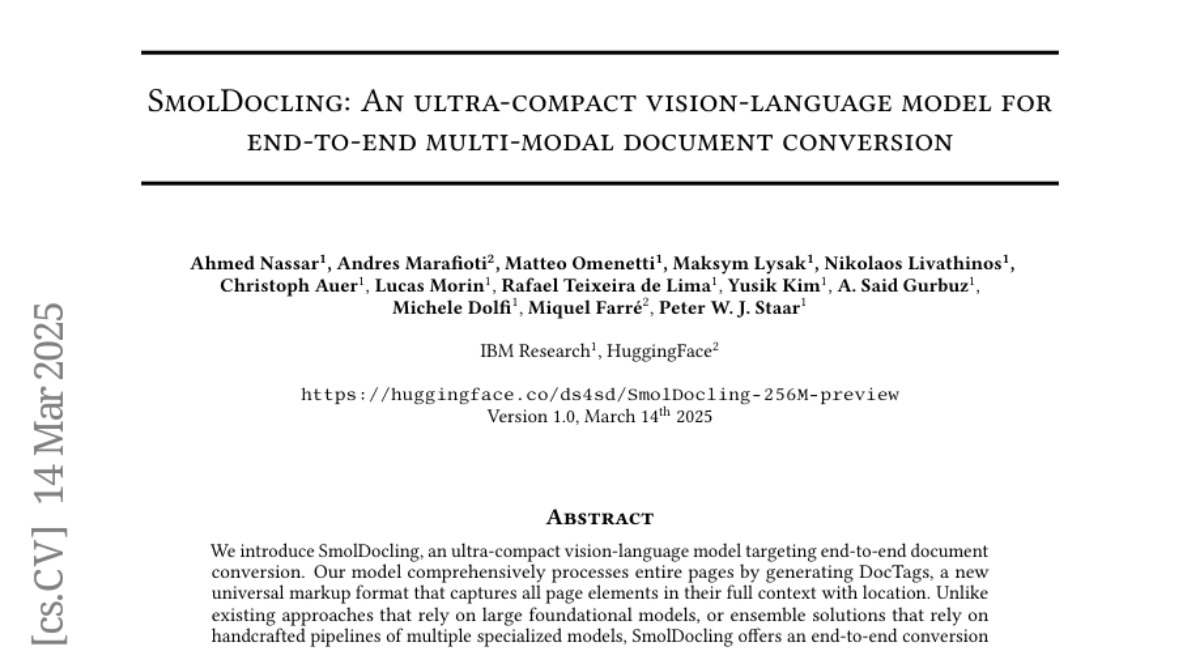
SmolDocling: An ultra-compact vision-language model for end-to-end multi-modal document conversion

SmolDocling is a compact vision-language model that performs end-to-end document conversion with robust performance across various document types using 256M parameters and a new markup format.

ibm-granite IBM Granite · Mar 14, 2025

TradingAgents: Multi-Agents LLM Financial Trading Framework

A multi-agent framework using large language models for stock trading simulates real-world trading firms, improving performance metrics like cumulative returns and Sharpe ratio.

  • 4 authors
· Dec 28, 2024
Submitted by
akhaliq

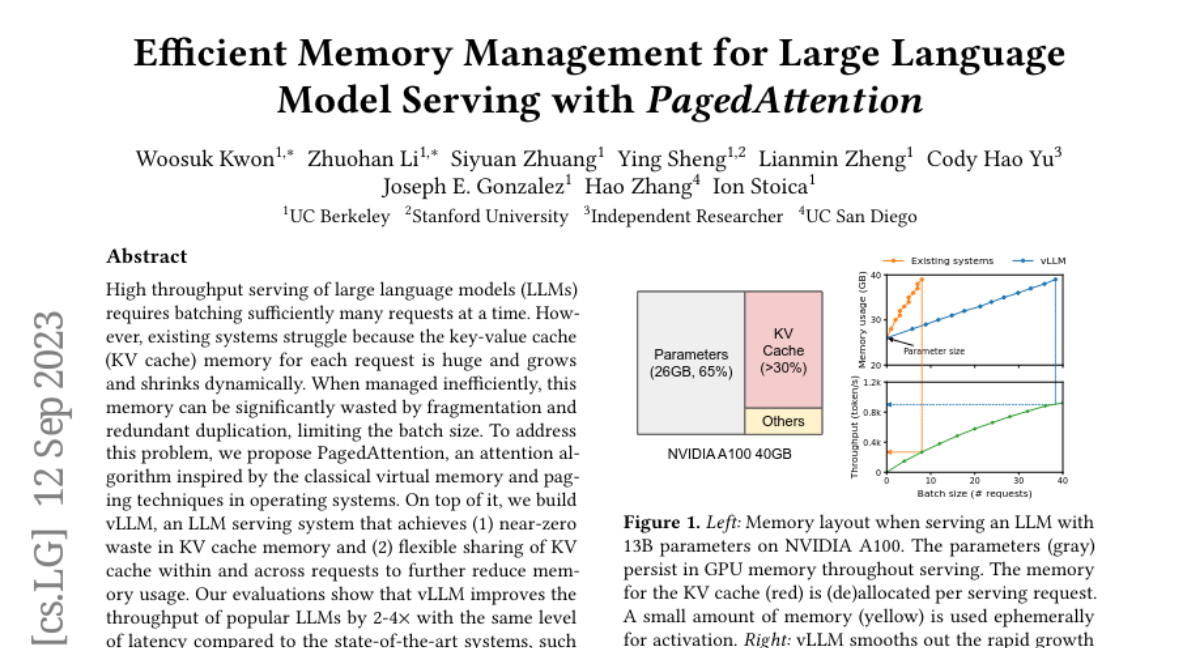
Efficient Memory Management for Large Language Model Serving with PagedAttention

PagedAttention algorithm and vLLM system enhance the throughput of large language models by efficiently managing memory and reducing waste in the key-value cache.

  • 9 authors
· Sep 12, 2023
Submitted by
Dongchao

HeartMuLa: A Family of Open Sourced Music Foundation Models

A suite of open-source music foundation models is introduced, featuring components for audio-text alignment, lyric recognition, music coding, and large language model-based song generation with controllable attributes and scalable parameterization.

  • 28 authors
· Jan 15, 2026
Submitted by
zhuhz22

Causal Forcing: Autoregressive Diffusion Distillation Done Right for High-Quality Real-Time Interactive Video Generation

A novel Causal Forcing method addresses the architectural gap in distilling bidirectional video diffusion models into autoregressive models by using AR teachers for ODE initialization, significantly improving video generation performance.

Submitted by
hao-li

Agent READMEs: An Empirical Study of Context Files for Agentic Coding

Agentic coding tools receive goals written in natural language as input, break them down into specific tasks, and write or execute the actual code with minimal human intervention. Central to this process are agent context files ("READMEs for agents") that provide persistent, project-level instructions. In this paper, we conduct the first large-scale empirical study of 2,303 agent context files from 1,925 repositories to characterize their structure, maintenance, and content. We find that these files are not static documentation but complex, difficult-to-read artifacts that evolve like configuration code, maintained through frequent, small additions. Our content analysis of 16 instruction types shows that developers prioritize functional context, such as build and run commands (62.3%), implementation details (69.9%), and architecture (67.7%). We also identify a significant gap: non-functional requirements like security (14.5%) and performance (14.5%) are rarely specified. These findings indicate that while developers use context files to make agents functional, they provide few guardrails to ensure that agent-written code is secure or performant, highlighting the need for improved tooling and practices.

  • 11 authors
· Nov 17, 2025
Submitted by
taesiri

Kimi K2.5: Visual Agentic Intelligence

Kimi K2.5 is an open-source multimodal agentic model that enhances text and vision processing through joint optimization techniques and introduces Agent Swarm for parallel task execution.

moonshotai Moonshot AI · Feb 2, 2026
Submitted by
wanderkid

MinerU: An Open-Source Solution for Precise Document Content Extraction

MinerU is an open-source tool that enhances document content extraction using fine-tuned models and pre/postprocessing rules across diverse document types.

  • 18 authors
· Sep 27, 2024
Submitted by
taesiri

MinerU2.5: A Decoupled Vision-Language Model for Efficient High-Resolution Document Parsing

MinerU2.5, a 1.2B-parameter document parsing vision-language model, achieves state-of-the-art recognition accuracy with computational efficiency through a coarse-to-fine parsing strategy.

  • 61 authors
· Sep 26, 2025
Submitted by
edli

Scaling Multiagent Systems with Process Rewards

Multiagent systems are improved through per-action process rewards from AI feedback (MAPPA), enhancing credit assignment and sample efficiency for complex tasks.

YaleUniversity Yale University · Jan 30, 2026
Submitted by
Wendy-Fly

Idea2Story: An Automated Pipeline for Transforming Research Concepts into Complete Scientific Narratives

Offline knowledge construction through structured methodological graphs enables more reliable and scalable autonomous scientific discovery by reducing reliance on real-time literature processing.

AgentAlphaAGI AgentAlpha · Jan 28, 2026
Submitted by
taesiri

DeepSeek-OCR 2: Visual Causal Flow

DeepSeek-OCR 2 introduces DeepEncoder V2 that dynamically reorders visual tokens based on semantic content, enabling more human-like causal reasoning in 2D image understanding through cascaded 1D causal structures.

deepseek-ai DeepSeek · Jan 28, 2026
Submitted by
akhaliq

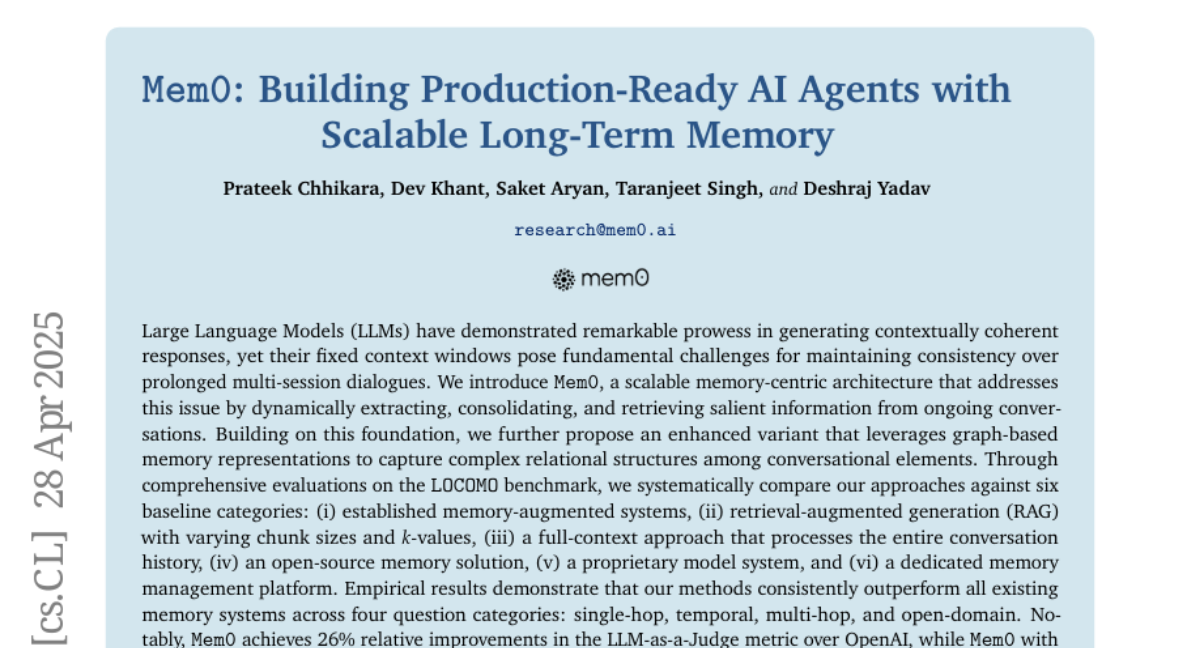
Mem0: Building Production-Ready AI Agents with Scalable Long-Term Memory

Mem0, a memory-centric architecture with graph-based memory, enhances long-term conversational coherence in LLMs by efficiently extracting, consolidating, and retrieving information, outperforming existing memory systems in terms of accuracy and computational efficiency.

  • 5 authors
· Apr 28, 2025
Submitted by
zehongma

PixelGen: Pixel Diffusion Beats Latent Diffusion with Perceptual Loss

PixelGen is a pixel-space diffusion framework that uses perceptual supervision through LPIPS and DINO-based losses to generate high-quality images without requiring VAEs or latent representations.

PekingUniversity Peking University · Feb 2, 2026
Submitted by
taesiri

MiniCPM-V 4.5: Cooking Efficient MLLMs via Architecture, Data, and Training Recipe

MiniCPM-V 4.5, a 8B parameter multimodal large language model, achieves high performance and efficiency through a unified 3D-Resampler architecture, a unified learning paradigm, and a hybrid reinforcement learning strategy.

  • 34 authors
· Sep 16, 2025
Submitted by
TianheWu

Diversity-Preserved Distribution Matching Distillation for Fast Visual Synthesis

A novel distillation framework called DP-DMD is introduced that preserves sample diversity in text-to-image generation by separating the roles of distilled steps, using v-prediction for diversity and standard DMD loss for quality refinement without additional computational overhead.

Submitted by
zkcys001

A Pragmatic VLA Foundation Model

A Vision-Language-Action model trained on extensive real-world robotic data demonstrates superior performance and generalization across multiple platforms while offering enhanced efficiency through optimized training infrastructure.

robbyant Robbyant · Jan 26, 2026
Submitted by
unilm

VibeVoice Technical Report

VibeVoice synthesizes long-form multi-speaker speech using next-token diffusion and a highly efficient continuous speech tokenizer, achieving superior performance and fidelity.

MicrosoftResearch Microsoft Research · Aug 26, 2025
Submitted by
CSJianYang

Evaluating and Aligning CodeLLMs on Human Preference

A human-curated benchmark (CodeArena) and a large synthetic instruction corpus (SynCode-Instruct) are introduced to evaluate code LLMs based on human preference alignment, revealing performance differences between open-source and proprietary models.

  • 10 authors
· Dec 6, 2024
Submitted by
wymanCV

Stable Video Infinity: Infinite-Length Video Generation with Error Recycling

Stable Video Infinity generates infinite-length videos with high temporal consistency and controllable storylines by using Error-Recycling Fine-Tuning on the Diffusion Transformer.

epfl-vita EPFL VITA Lab · Oct 10, 2025
Submitted by
akhaliq

LlamaFactory: Unified Efficient Fine-Tuning of 100+ Language Models

LlamaFactory is a unified framework enabling efficient fine-tuning of large language models across various tasks using a web-based user interface.

  • 5 authors
· Mar 20, 2024
Submitted by
cherubicxn

Masked Depth Modeling for Spatial Perception

LingBot-Depth is a depth completion model that uses visual context to refine depth maps through masked depth modeling and automated data curation for improved spatial perception in robotics and autonomous systems.

robbyant Robbyant · Jan 25, 2026

Continuous Audio Language Models

Audio Language Models (ALM) have emerged as the dominant paradigm for speech and music generation by representing audio as sequences of discrete tokens. Yet, unlike text tokens, which are invertible, audio tokens are extracted from lossy codecs with a limited bitrate. As a consequence, increasing audio quality requires generating more tokens, which imposes a trade-off between fidelity and computational cost. We address this issue by studying Continuous Audio Language Models (CALM). These models instantiate a large Transformer backbone that produces a contextual embedding at every timestep. This sequential information then conditions an MLP that generates the next continuous frame of an audio VAE through consistency modeling. By avoiding lossy compression, CALM achieves higher quality at lower computational cost than their discrete counterpart. Experiments on speech and music demonstrate improved efficiency and fidelity over state-of-the-art discrete audio language models, facilitating lightweight, high-quality audio generation. Samples are available at https://continuous-audio-language-models.github.io

  • 5 authors
· Sep 8, 2025
Submitted by
Lingaaaaaaa

RLAnything: Forge Environment, Policy, and Reward Model in Completely Dynamic RL System

RLAnything enhances reinforcement learning for LLMs and agents through dynamic model optimization and closed-loop feedback mechanisms that improve policy and reward model training.

princeton-ai Princeton AI Lab · Feb 2, 2026

Self-Supervised Prompt Optimization

A self-supervised framework optimizes prompts for both closed and open-ended tasks by evaluating LLM outputs without external references, reducing costs and required data.

  • 9 authors
· Feb 7, 2025

UltraRAG: A Modular and Automated Toolkit for Adaptive Retrieval-Augmented Generation

UltraRAG is a comprehensive RAG toolkit that automates knowledge adaptation across the entire workflow while providing a user-friendly interface for non-coding deployment.
  • 15 authors
· Mar 31, 2025
Submitted by
Cxxs

Decoupled DMD: CFG Augmentation as the Spear, Distribution Matching as the Shield

The study reveals that in text-to-image generation, CFG Augmentation is the primary driver of few-step distillation in Distribution Matching Distillation (DMD), while the distribution matching term acts as a regularizer.

Tongyi-MAI Tongyi-MAI · Nov 27, 2025
Submitted by
Paper99

Z-Image: An Efficient Image Generation Foundation Model with Single-Stream Diffusion Transformer

Z-Image, a 6B-parameter Scalable Single-Stream Diffusion Transformer (S3-DiT) model, achieves high-performance image generation with reduced computational cost, offering sub-second inference and compatibility with consumer hardware.

Tongyi-MAI Tongyi-MAI · Nov 27, 2025
Submitted by
taesiri

LTX-2: Efficient Joint Audio-Visual Foundation Model

LTX-2 is an open-source audiovisual diffusion model that generates synchronized video and audio content using a dual-stream transformer architecture with cross-modal attention and classifier-free guidance.

  • 29 authors
· Jan 6, 2026

IndexTTS: An Industrial-Level Controllable and Efficient Zero-Shot Text-To-Speech System

IndexTTS, an enhanced text-to-speech system combining XTTS and Tortoise models, offers improved naturalness, enhanced voice cloning, and controllable usage through hybrid character-pinyin modeling and optimized vector quantization.

  • 5 authors
· Feb 8, 2025
Submitted by
akhaliq

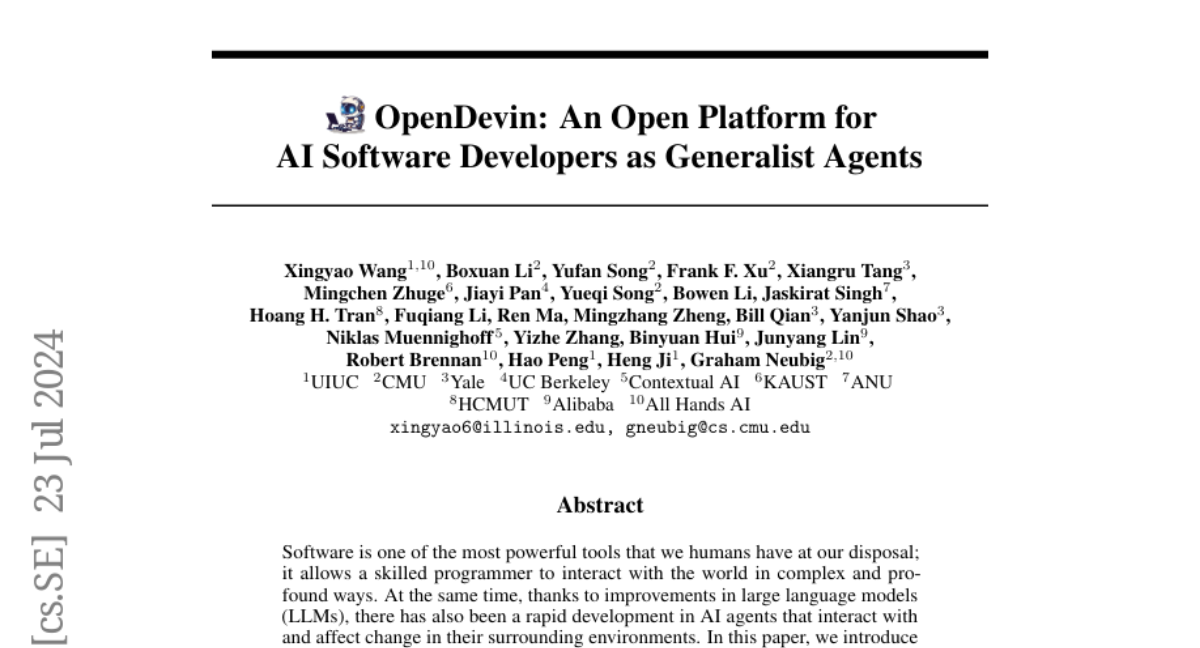
OpenDevin: An Open Platform for AI Software Developers as Generalist Agents

OpenDevin is a platform for developing AI agents that interact with the world by writing code, using command lines, and browsing the web, with support for multiple agents and evaluation benchmarks.

  • 24 authors
· Jul 23, 2024
Submitted by
jonhue

Reinforcement Learning via Self-Distillation

Self-Distillation Policy Optimization (SDPO) enhances reinforcement learning with verifiable rewards by utilizing rich textual feedback to improve sample efficiency and accuracy in language model training.

lasgroup LAS @ ETH Zurich · Jan 28, 2026
Submitted by
lovesnowbest

UI-TARS-2 Technical Report: Advancing GUI Agent with Multi-Turn Reinforcement Learning

UI-TARS-2, a native GUI-centered agent model, addresses challenges in data scalability, multi-turn reinforcement learning, and environment stability, achieving significant improvements over its predecessor and strong baselines across various benchmarks.

ByteDance-Seed ByteDance Seed · Sep 2, 2025
Submitted by
akhaliq

UI-TARS: Pioneering Automated GUI Interaction with Native Agents

UI-TARS, a native GUI agent model using screenshots as input, outperforms commercial models in various benchmarks through enhanced perception, unified action modeling, system-2 reasoning, and iterative training with reflective online traces.

  • 35 authors
· Jan 21, 2025

ACE-Step: A Step Towards Music Generation Foundation Model

ACE-Step is an open-source music generation model that integrates diffusion generation with a lightweight transformer and deep compression autoencoder, achieving fast inference, high coherence, and fine control over music elements.

  • 5 authors
· May 28, 2025
Submitted by
SereinH

Mind-Brush: Integrating Agentic Cognitive Search and Reasoning into Image Generation

Mind-Brush presents a unified agentic framework for text-to-image generation that dynamically retrieves multimodal evidence and employs reasoning tools to improve understanding of implicit user intentions and complex knowledge reasoning.

  • 9 authors
· Feb 2, 2026
Submitted by
JiaaqiLiu

SimpleMem: Efficient Lifelong Memory for LLM Agents

To support reliable long-term interaction in complex environments, LLM agents require memory systems that efficiently manage historical experiences. Existing approaches either retain full interaction histories via passive context extension, leading to substantial redundancy, or rely on iterative reasoning to filter noise, incurring high token costs. To address this challenge, we introduce SimpleMem, an efficient memory framework based on semantic lossless compression. We propose a three-stage pipeline designed to maximize information density and token utilization: (1) Semantic Structured Compression, which applies entropy-aware filtering to distill unstructured interactions into compact, multi-view indexed memory units; (2) Recursive Memory Consolidation, an asynchronous process that integrates related units into higher-level abstract representations to reduce redundancy; and (3) Adaptive Query-Aware Retrieval, which dynamically adjusts retrieval scope based on query complexity to construct precise context efficiently. Experiments on benchmark datasets show that our method consistently outperforms baseline approaches in accuracy, retrieval efficiency, and inference cost, achieving an average F1 improvement of 26.4% while reducing inference-time token consumption by up to 30-fold, demonstrating a superior balance between performance and efficiency. Code is available at https://github.com/aiming-lab/SimpleMem.

  • 8 authors
· Jan 5, 2026
Submitted by
dyyyyyyyy

FAPO: Flawed-Aware Policy Optimization for Efficient and Reliable Reasoning

Flawed-Aware Policy Optimization (FAPO) enhances reinforcement learning with verifiable rewards by penalizing flawed-positive rollouts, improving reasoning capability and training stability in large language models.

  • 6 authors
· Oct 26, 2025
Submitted by
taesiri

AgentScope 1.0: A Developer-Centric Framework for Building Agentic Applications

AgentScope enhances agentic applications by providing flexible tool-based interactions, unified interfaces, and advanced infrastructure based on the ReAct paradigm, supporting efficient and safe development and deployment.

  • 23 authors
· Aug 22, 2025